As orders from the new energy, automation equipment, and industrial framing sectors keep growing, more and more aluminum processors are being asked to machine large-section solid aluminum billets and oversized U-shaped aluminum profiles. Many factories run into the same wall after buying a standard aluminum cutting machine: the frame shakes and the blade stalls on solid stock, the cut face is wavy and dimensions drift out of tolerance. Clamping oversized U-profiles is unstable, and the scrap rate climbs.
A band saw is the usual fallback — but band saws cut slowly and leave a rough end face, so they struggle to keep up with high-volume delivery schedules. To address these large-section cutting problems, Shuangdeyu Precision Machinery (Suzhou) Co., Ltd. developed the SDY-QF650-Z heavy-duty hydraulic aluminum cutting machine. With its reinforced frame and high-power drive, it is built for large solid aluminum and oversized irregular profiles — and it is already running in several customer plants.
1. Four Pain Points in Large-Section Aluminum Cutting
Standard aluminum cutting machines are designed around small and medium aluminum profiles. The moment you load a 170 × 140 mm solid aluminum billet or a 420 × 130 mm U-shaped profile, their limitations surface all at once:
- Insufficient frame rigidity — vibration during the cut. Cutting solid aluminum generates heavy resistance. A light-duty frame vibrates visibly, the blade deflects, wave marks appear on the cut face, accuracy is lost, and the part is scrapped.
- Not enough motor power — the blade jams. Large cross-sections put a high load on the cut. A low-power motor stalls under the load, the blade wears faster, consumable costs rise, and frequent stoppages break up the production rhythm.
- Limited stroke — the workpiece will not fit. Standard machines have limited cutting width and height. Large U-profiles and thick solid stock simply do not fit, so the part has to be split into multiple machining operations, adding process cost.
- A choice between two imperfect methods. Many factories keep a band saw as a backup. It can handle large stock, but cutting speed is slow, the end face is rough, and downstream grinding becomes heavy work — output cannot keep up with high-volume orders.
Industry reality: orders for large-section aluminum are increasing year after year, yet heavy-duty circular aluminum cutting machines built for this size range are still rare on the market, leaving many processors without a suitable equipment option.
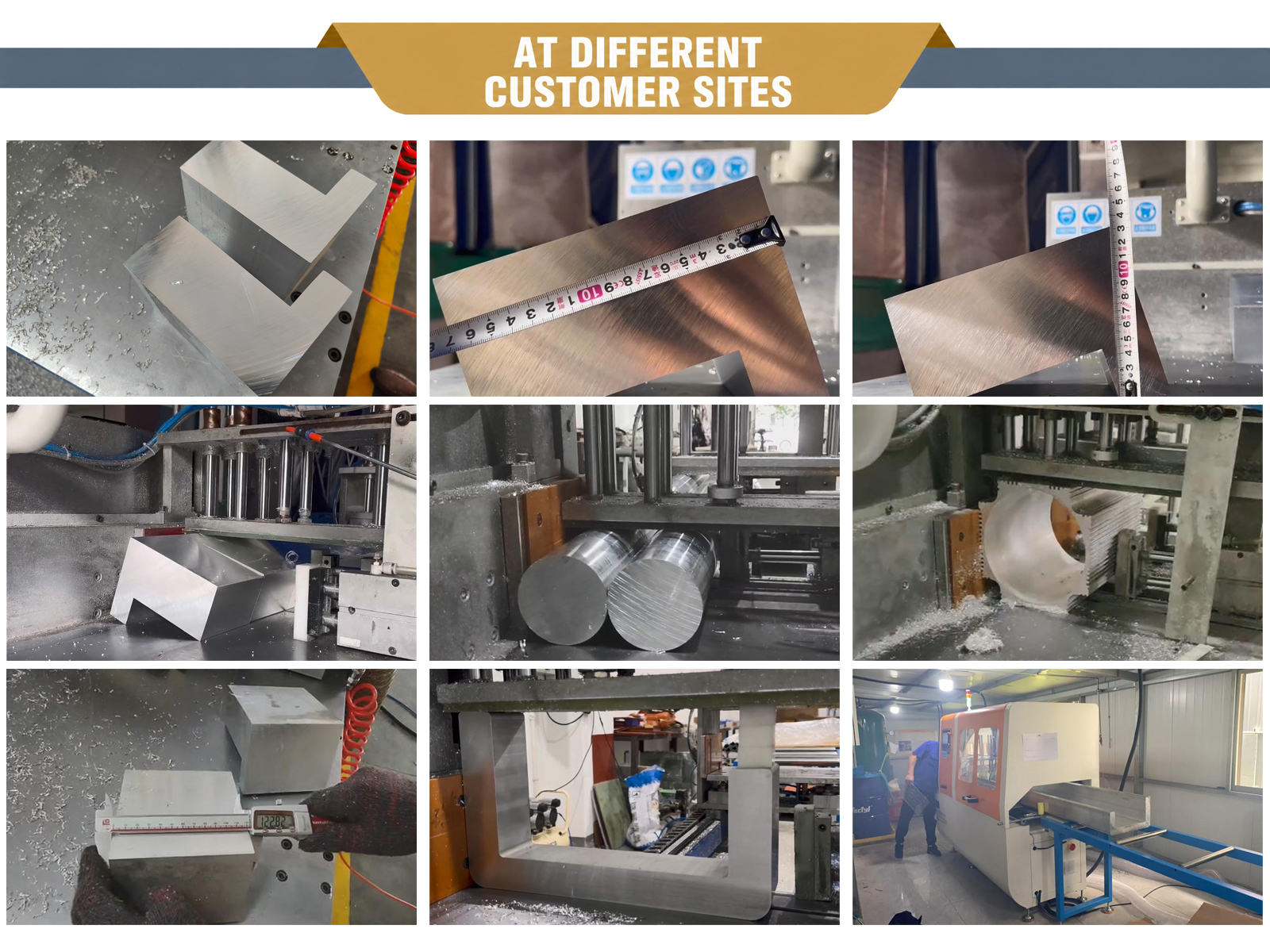
2. SDY-QF650-Z Heavy-Duty Hydraulic Aluminum Cutting Machine: Rigid Structure, Full Power Reserve
Stable cutting of large solid aluminum and oversized irregular profiles comes down to two things: enough frame rigidity and enough power in reserve.
- Matched to real customer applications. Customers in the field are machining 170 × 140 mm solid aluminum and 420 × 130 mm U-shaped aluminum. A standard aluminum cutting machine cannot handle either; the SDY-QF650-Z takes on both.
- Core advantages. A heavy-duty machine structure with a solid, rigid frame suppresses cutting vibration. A high-power main motor delivers ample cutting force, so solid billets with high cutting resistance rarely stall the machine. With a maximum cutting width of 480 mm and a maximum cutting height of 230 mm, large-section solid aluminum and oversized U-shaped profiles can be cut in a single pass.
- Proven in production. Several aluminum processing companies have already put the machine into production, cutting in stable batches on site, holding cutting accuracy within ±0.1 mm and producing a clean end face that reduces secondary grinding work.
Best-fit applications: large-section solid aluminum billets, oversized U-shaped and irregular aluminum profiles, and thick industrial aluminum profiles — for processors with high requirements on both cutting efficiency and end-face quality.
3. Band Saw vs. Heavy-Duty Circular Saw: Which Cutting Method for Large Aluminum?
When selecting equipment for large aluminum stock, many buyers weigh a band saw against a circular saw. Each route has its own logic:
| Band saw | Heavy-duty circular saw (SDY-QF650-Z) | |
|---|---|---|
| Cutting capacity | Handles very large cross-sections | Up to 480 mm wide × 230 mm high |
| Equipment investment | Relatively lower | Higher |
| Cutting speed | Slow | High |
| Cut face | Rough — manual grinding is usually required afterwards | Smooth and flat |
| Dimensional accuracy | Lower | High, stable (±0.1 mm) |
| Secondary processing | Heavy grinding workload | Reduced grinding, shorter lead time |
| Best suited to | Low-volume rough cutting without end-face requirements | High-volume production with end-face and dimensional requirements |
Selection advice: if order volumes are high and you need a clean cut face with stable dimensions, prioritize a heavy-duty circular aluminum cutting machine. If you only cut roughly, in small batches, a band saw can be the more economical route.
4. SDY-QF650-B: Full Specifications
Note: The SDY-QF650-Z heavy-duty hydraulic model shares these base specifications, referenced to the SDY-QF650-B.
| Item | Specification |
|---|---|
| Model | SDY-QF650-B |
| Power supply | 380V / 50Hz |
| Air pressure | 0.5–0.8 MPa |
| Main motor power | 5.5 kW (depends on material) |
| Spindle speed | 2850 rpm (variable frequency drive supported) |
| Max. cutting width | 480 mm |
| Max. cutting height | 230 mm |
| Cutting accuracy | ±0.1 mm |
| Blade cooling | Minimum quantity lubrication (MQL) |
| Blade size | Φ650 mm, downward compatible |
| Feed servo motor power | 1.5 kW |
| Saw infeed servo motor power | 1.5 kW |
| Remnant (residual material) servo motor power | 750 W (available on no-remnant models) |
| Dust collector power | 5.5 kW |
| Single feed stroke | 850 / 1200 mm (with reciprocating continuous feeding) |
| Overall dimensions | Approx. 3000 × 1700 × 1850 mm |
5. Selection Summary: Judge Frame Rigidity and Power Reserve First
When choosing a machine for large-section aluminum cutting, do not look only at price. Evaluate three things: frame rigidity, main motor power, and cutting stroke.
- For 170 × 140 mm solid aluminum billets and 420 × 130 mm U-shaped aluminum profiles, the SDY-QF650-Z heavy-duty hydraulic aluminum cutting machine is the priority choice.
- For small-batch rough cutting with no end-face requirement, a band saw remains a viable option.
Shuangdeyu Precision Machinery (Suzhou) Co., Ltd. has deep experience in the aluminum processing industry and a large base of field-proven aluminum cutting cases. When purchasing heavy-duty aluminum cutting equipment, buyers can evaluate it against their own profile cross-section, accuracy requirements, and capacity needs — and against real customer cases at the same working conditions.
Final Note
Industrial aluminum profile specifications continue to diversify, and orders for large-section solid aluminum and oversized irregular profiles continue to grow. Aluminum cutting is the first step of the production line — the equipment selected directly affects yield, labor cost, and delivery time. Before investing in a heavy-duty cutting machine, we recommend reviewing customer cases under the same working conditions to verify real cutting performance and reduce the risk of the investment.
FAQ
What sizes can the SDY-QF650-Z cut? Maximum cutting width is 480 mm and maximum cutting height is 230 mm, covering large-section solid aluminum billets and oversized U-shaped profiles in a single pass.
Can it cut 170 × 140 mm solid aluminum billets? Yes. Machines are already running in customer plants on 170 × 140 mm solid aluminum and 420 × 130 mm U-shaped aluminum, holding accuracy within ±0.1 mm.
Is a band saw better than a circular saw for large aluminum? A band saw handles very large cross-sections at a lower investment, but cuts slowly and leaves a rough end face. A heavy-duty circular saw cuts faster with a smoother, more accurate finish — better suited to high-volume orders with end-face requirements.
What cutting accuracy can I expect? Cutting accuracy is stable within ±0.1 mm on site, with a clean end face that reduces secondary grinding.
How is the blade cooled? The machine uses minimum quantity lubrication (MQL), which keeps the blade lubricated with minimal coolant consumption.